A peer review journal published by the university of queensland in 2013 found.
Rule of thumb pv size for flat roof.

Some building codes start at one quarter of an inch per foot or two percent.
A comparison of data in two us cities has been completed to exhibit the importance of a solar pv array s tilt angle.
The theoretical optimum configuration is approximately 26 degrees north for tilt angles with pv panels facing true north for orientation.
Here you can see that the rule of thumb is less accurate.
What is the general area of a flat 1 4 1 0 slope single ply roof for each roof drain ratio for the number of roof drains roof area.
A good rule of thumb for local shading is don t place modules anywhere that is closer then 3x the height of the obstacle from the object.
If a stink pipe is 12 inches don t place any module north east or west of it closer then 36 inches away.
The effect of an array s tilt angle on solar pv energy output may be up to 20 compared to that of flat installations.
As a general rule of thumb energy output can be optimized by adding 15 degrees to a site s latitude in the winter and subtracting 15 degrees to a site s.
Is there a rule of thumb for number of roof drains needed on flat roofs.
How to calculate the drainage requirements for flat roofs reader question.
It would be equivalent to laying solar panels flat at the equator.
6 24 2014 david howard aia said.
But it turns this rule of thumb is not entirely correct.
Again the green line represents the rule of thumb orientation.
You can still place module south of the local shading areas.
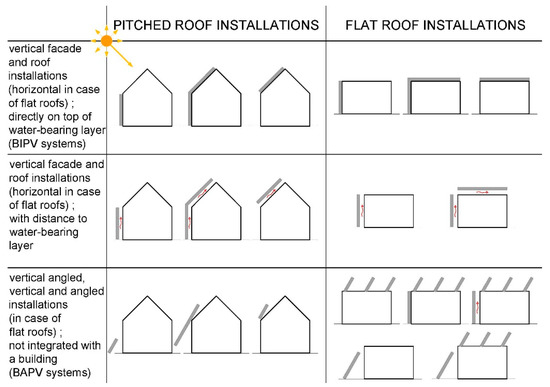
A panel mounted horizontally flush on a flat roof has an angle of 0 and a panel mounted vertically flush on a wall has an angle of 90.
On flat roofs panels are fitted on mounting systems usually at a slope of around 15 degrees.